QBR vs Passer Rating: What QBR Means and How They Differ
Learn what QBR means, how ESPN Total QBR differs from NFL passer rating, what each metric measures, and when to use QBR, RTG, or QB rating.
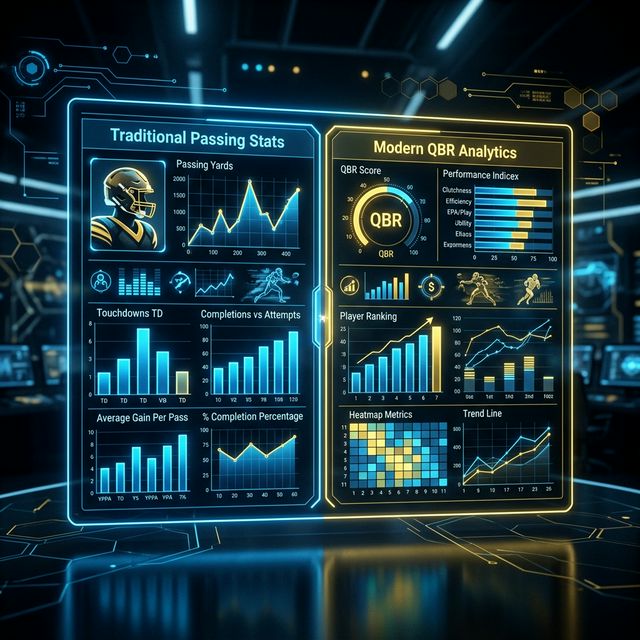
QBR, or Total Quarterback Rating, is ESPN’s 0–100 measure of a quarterback’s total efficiency. It evaluates passing, rushing, sacks, turnovers, penalties, game situation and opponent strength. NFL passer rating uses only completions, attempts, passing yards, passing touchdowns and interceptions on a 0–158.3 scale.
That distinction answers the central question: passer rating measures passing efficiency, while QBR estimates the quarterback’s overall contribution per play. The metrics overlap, but they are not interchangeable.
Quick terminology check
Passer rating, QB rating and RTG usually refer to the traditional NFL formula. QBR usually means ESPN Total QBR. Our NFL passer rating calculator calculates passer rating—not ESPN’s proprietary Total QBR.
QBR vs passer rating at a glance
| Attribute | ESPN Total QBR | NFL passer rating |
|---|---|---|
| Primary purpose | Estimate total quarterback efficiency | Measure passing efficiency |
| Scale | 0–100 | 0–158.3 |
| Average reference point | About 50 | Varies by season and era |
| Passing plays | Included | Included |
| Designed runs and scrambles | Included | Excluded |
| Sacks and fumbles | Included | Excluded |
| Down, distance, field position and score | Included | Excluded |
| Opponent adjustment | Included in adjusted QBR | Not included |
| Publicly reproducible | No | Yes |
| Best use | Evaluating overall QB impact | Comparing box-score passing efficiency |
What is QBR in football?
QBR stands for Total Quarterback Rating. ESPN introduced the metric to estimate how efficiently a quarterback contributes to his team’s performance across nearly every play in which he is involved.
QBR begins with expected points added, commonly called EPA. EPA estimates how a play changes the offense’s expected points based on the situation before and after the play. A five-yard gain on third-and-3 can improve the offense’s position by earning a first down; the same gain on third-and-10 can end the drive. QBR can distinguish between those outcomes because it uses play context.
ESPN’s published explanation says Total QBR considers:
- Passes, including air yards and outcomes after the catch
- Designed quarterback runs and scrambles
- Sacks, fumbles and other turnovers
- Some quarterback-related penalties
- Down, distance, field position, score and time remaining
- The strength of the opposing defense
- Reduced weight for plays after a game is effectively decided
The adjusted efficiency is placed on a 0–100 scale, where 50 represents approximately average performance. ESPN describes a season-long QBR around 75 as elite or Pro Bowl-level efficiency.
How is QBR calculated?
There is no short QBR equation that can be reproduced from a standard box score. ESPN explains the methodology at a high level, but the complete implementation depends on play-by-play and video-tracking inputs that are not all publicly available.
The calculation can be understood as a sequence:
- Measure the play’s EPA. Determine how the quarterback’s play changed expected points.
- Divide responsibility. Estimate how much credit or blame belongs to the quarterback rather than receivers, blockers or other teammates.
- Include all quarterback play types. Add passes, sacks, scrambles, designed runs, turnovers and relevant penalties.
- Adjust the context. Account for opponent quality and reduce the influence of garbage-time plays.
- Convert efficiency to the QBR scale. Translate the adjusted per-play result to a value from 0 to 100.
This is why a website using only completions, attempts, yards, touchdowns and interceptions cannot produce an authentic ESPN Total QBR. It can calculate the transparent NFL passer rating formula, but it lacks the contextual and tracking data required for QBR.
What is NFL passer rating?
NFL passer rating is a fixed formula that measures four passing attributes: completion percentage, yards per attempt, touchdown percentage and interception percentage. The NFL adopted the current system in 1973. Each component is limited to a value between 0 and 2.375, producing a final score between 0 and 158.3.
The required inputs are:
- Completions
- Pass attempts
- Passing yards
- Passing touchdowns
- Interceptions
Because those values are available in any box score, passer rating is transparent and independently reproducible. You can inspect every step in our NFL passer rating formula guide or calculate a result immediately with the QB rating calculator.
Passer rating does not measure rushing value, sacks, fumbles, down-and-distance difficulty, game score, opponent strength or receiver contribution. It rates the pass result, not the quarterback’s complete performance.
Why can QBR and passer rating disagree?
The metrics disagree when the context around the quarterback’s box-score passing line changes its value.
High passer rating but lower QBR
A quarterback may complete efficient passes while adding little total value if many gains occur after the outcome is nearly decided, if receivers create most of the yardage after the catch, or if sacks and fumbles erase productive pass plays. Passer rating sees the strong passing line; QBR also evaluates the negative and lower-leverage plays.
Lower passer rating but higher QBR
A mobile quarterback may create first downs with scrambles, avoid sacks, convert difficult situations and add value on designed runs. Those plays can lift QBR even though none of them improves passer rating.
Similar scores do not mean the same thing
A passer rating of 95 and a QBR of 95 are not equivalent. They use different scales, inputs and reference points. Compare each metric with other values from the same metric, season and competition level.
Is QBR better than passer rating?
QBR is broader, but passer rating is more transparent. Which is better depends on the question being asked.
Use passer rating when the question is:
- How efficient was the player as a passer?
- How did two box-score passing lines compare?
- What result does the official NFL formula produce?
- How did passing efficiency change across a season or career?
Use QBR when the question is:
- How efficient was the quarterback across passing and rushing plays?
- Did sacks, fumbles and game situation change the value of the performance?
- How did opponent strength affect the evaluation?
- How much did the quarterback contribute on a per-play basis?
For detailed analysis, use several measures together. Passer rating supplies a stable passing baseline; ANY/A and advanced quarterback metrics add sacks and scoring weights; QBR and EPA add play context. Agreement across multiple measures is more informative than treating any one number as a complete verdict.
QBR, RTG and quarterback rating: what do the abbreviations mean?
Football broadcasts and scoreboards frequently shorten passer rating to RTG. Fans also call it QB rating or quarterback rating. In most NFL box scores, those labels refer to the traditional 0–158.3 formula.
QBR is different. ESPN uses the abbreviation for Total Quarterback Rating, its 0–100 contextual efficiency metric. When comparing statistics, check the scale:
- A maximum of 158.3 identifies NFL passer rating.
- A scale from 0 to 100, with 50 near average, identifies Total QBR.
- College passing efficiency uses another formula and an uncapped scale; use the NCAA passer rating calculator for that system.
What is a good QBR?
On ESPN’s scale, 50 is approximately average, 75 is elite over a season and values near 100 represent exceptional efficiency. These are reference points rather than fixed performance labels. A single-game score is more volatile than a season-long score, and the opponent adjustment can change how two similar stat lines are evaluated.
Do not compare a QBR directly with the NFL passer rating scale. A 75 QBR and a 75 passer rating describe different levels of performance because the formulas and scales are unrelated.
Limitations of both quarterback metrics
No one-number metric captures every responsibility on a football play.
Passer rating is limited because it excludes context, rushing and sacks. QBR is limited because its exact calculation cannot be fully reproduced from public box-score data, and any credit-allocation model requires assumptions about teammates and responsibility.
Both metrics are efficiency measures. Neither automatically describes total season volume, play-calling difficulty, receiver separation, pass protection quality or every coaching assignment. Film, play-by-play data and complementary statistics remain necessary for a complete evaluation.
Frequently asked questions
Frequently Asked Questions
Everything you need to know about passer rating and how to calculate it.
What does QBR stand for?
QBR stands for Total Quarterback Rating. ESPN uses it for a 0-to-100 metric designed to measure a quarterback's total per-play efficiency, including passing, rushing, sacks, turnovers and game context.
What is the difference between QBR and passer rating?
QBR evaluates total quarterback efficiency with play context on a 0-to-100 scale. NFL passer rating evaluates only completions, yards, touchdowns and interceptions on a 0-to-158.3 scale.
Can I calculate ESPN QBR from a box score?
No. A standard box score does not contain all the play context, opponent adjustments and tracking information used by ESPN Total QBR. You can calculate NFL passer rating from five box-score inputs.
Is QBR the same as QB rating?
Usually not. QB rating commonly means the traditional NFL passer rating, while QBR usually means ESPN Total QBR. Check whether the displayed scale is 158.3 or 100.
What is a good QBR in the NFL?
A QBR near 50 is approximately average. ESPN describes a season-long QBR around 75 as elite or Pro Bowl-level efficiency, while scores near 100 are exceptional.
Does QBR include rushing yards?
QBR includes designed quarterback runs and scrambles as part of overall quarterback efficiency. Traditional passer rating excludes all rushing production.
Does passer rating include sacks?
No. NFL passer rating uses pass attempts, completions, passing yards, passing touchdowns and interceptions. Sacks are not pass attempts and do not enter its formula.
Which metric should I use to compare quarterbacks?
Use passer rating for transparent passing efficiency, QBR for contextual total efficiency, and advanced metrics such as ANY/A or EPA for additional perspectives. Comparing several metrics is more reliable than using one alone.
Methodology sources
Use the passer rating calculator for the official NFL box-score formula, then read the result beside QBR when you need both passing efficiency and total contextual efficiency.