NFL Passer Rating vs ESPN QBR: Which Metric Is Better?
Compare the traditional NFL passer rating with ESPN's Total QBR. Discover the semantic differences, strengths, weaknesses, and exactly which quarterback evaluation metric is better.
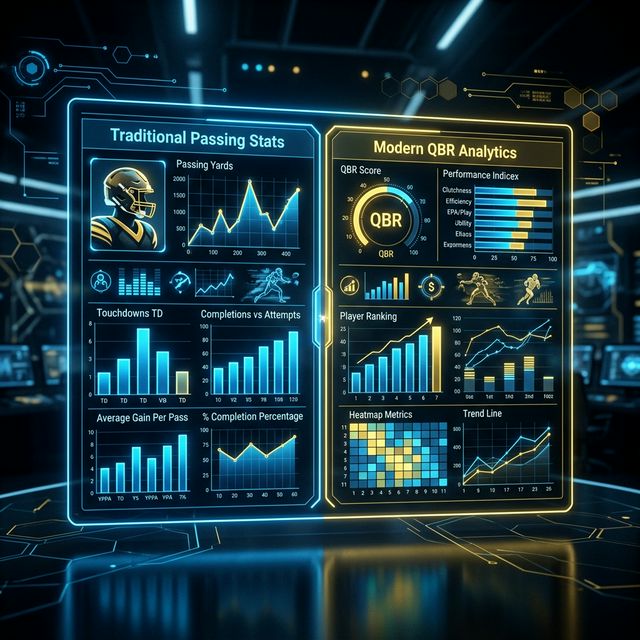
Two statistics dominate the debate over how to measure NFL quarterback performance and efficiency: the traditional NFL passer rating and ESPN’s Total Quarterback Rating (QBR). But which one is truly better for evaluating a player’s impact on the field?
What is the difference between NFL Passer Rating and ESPN QBR?
The NFL passer rating evaluates quarterbacks strictly on box score passing statistics like completions and touchdowns, whereas ESPN QBR measures a quarterback’s total value using an expected points framework that includes rushing, sacks, and clutch game situations.
Understanding when to use each metric is key to correctly assessing a quarterback’s total performance.
The Classic: NFL Passer Rating Explained
The NFL passer rating has been the league’s official passing efficiency metric since 1973. It relies on four core components: completion percentage, yards per attempt, touchdown percentage, and interception rate. These combine to produce a score on a unique 0 to 158.3 scale.
If you want to dive deeper into the mathematics behind this, check out our complete breakdown on Understanding the NFL Passer Rating Formula.
Strengths of the Traditional Rating
- Transparent formula — Unlike proprietary metrics, anyone can calculate it.
- Historical comparability — With decades of historical box-score data available, you can compare modern stars to legends from the 1980s.
- Pure passing evaluation — It is completely objective and strictly isolates a quarterback’s passing accuracy and arm efficiency.
Weaknesses of the Traditional Rating
- Ignores rushing value — It presents a huge gap for mobile, dual-threat quarterbacks who generate significant offense on the ground.
- No situational context — A meaningless “garbage time” touchdown against a prevent defense counts exactly the same as a game-winning throw in the Super Bowl.
- Ignores sacks — A quarterback who holds the ball too long and takes drive-killing sacks is not penalized in this formula.
The Modern Alternative: ESPN’s Total QBR
Introduced in 2011, ESPN’s Total QBR attempts to measure a quarterback’s comprehensive contribution to winning on a simplified 0-100 scale. It is built on an Expected Points Added (EPA) framework, representing modern football analytics.
Strengths of QBR
- Includes rushing — Fully captures the dual-threat value of modern quarterbacks.
- Situational weighting — Big moments and third-down conversions count significantly more than empty yards in blowouts.
- Accountability — Splits credit between the quarterback and receivers (e.g., separating air yards from yards after the catch).
Weaknesses of QBR
- Proprietary formula — The exact calculations are a closely guarded secret by ESPN and cannot be independently verified by third-party analysts.
- Limited history — Granular play-by-play data is only reliably available dating back to 2006, making cross-era historical comparisons impossible.
Frequently Asked Questions
Does QBR account for rushing?
Yes, ESPN QBR specifically penalizes fumbles and rewards rushing yards to capture the true dual-threat value of modern mobile quarterbacks, whereas the traditional passer rating only evaluates passing production.
Which rating do NFL analysts prefer?
Both metrics are utilized across the league. Modern data analysts tend to favor ESPN’s QBR for evaluating overall holistic performance and win probability, while traditional scouts prefer the classic NFL passer rating for evaluating pure passing efficiency and historical tracking.
The Bottom Line
Neither metric is undeniably perfect. The NFL passer rating excels at what it was fundamentally designed to do: measure passing efficiency purely from box score stats. Meanwhile, QBR attempts a much more contextual, comprehensive evaluation but sacrifices transparency. For most football fans and analysts, using both metrics together provides the most accurate and complete picture of quarterback performance.
To see how history’s best stack up using the traditional metric, explore the Top 10 Single-Season Passer Ratings in NFL History.